Walking into a testing center for the first time can be nerve-wracking. The stakes are real: a certification, a license, a career move. You've studied for weeks or months, and now you're standing at a reception desk wondering what happens next.
Here's the short version: it's a calm, structured process, and every step is there for a reason. Once you know what to expect, the test-day experience becomes the easiest part of the whole endeavor.
1. Registration happens online, not at the center
Before you walk in, you've already registered on Pearson VUE's website (or through your certification body's portal that connects to Pearson VUE). Registration includes:
- Choosing your exam
- Selecting a test center — we hope you pick a BLE Training testing center
- Picking a date and time
- Paying the exam fee
When you complete registration, you receive a confirmation email with your appointment details. Print it or save it to your phone. You'll need it on test day.
A tip most people miss: don't schedule your exam for a morning you'll be rushed. Pick a time when you can arrive calm, ideally a day when you don't have other major commitments. Your brain needs the runway.
2. What to bring — and what to leave behind
Bring
- Two forms of valid ID.The primary ID must be government-issued with a photo (driver's license, passport, military ID). The secondary ID needs a signature (credit card, debit card, employer ID). Both pieces must show your name exactly as it appears on your registration.
- Your confirmation email — printed or on your phone.
- Nothing else you need for the exam. Pearson VUE provides everything required: scratch paper or a whiteboard, a pencil, and a computer.
Leave behind (or plan to lock away)
- Phones, smartwatches, and any wearable tech
- Bags, backpacks, wallets, coats
- Food, drinks (most centers have a water cooler)
- Notes, books, study materials
- Hats, sunglasses, headphones
Every BLE Training center has secure lockers for your belongings. You'll store everything before check-in.
3. Arrive 30 minutes early
Arriving early is not optional — it's how you give yourself a stress-free check-in. Here's what happens in those 30 minutes:
- Minutes 0–10 — Arrival and greeting.The proctor confirms your appointment, checks your ID, and walks you through the center's rules.
- Minutes 10–20 — Biometric check-in. Pearson VUE uses biometric verification: a palm vein scan, a photo, and a digital signature. It sounds intense; it takes four minutes.
- Minutes 20–30 — Locker storage and final walk-through. You'll store all personal items, empty your pockets, and sometimes be asked to turn out your pockets or roll up long sleeves. The proctor then walks you to your workstation.
If you're late by more than 15 minutes, most testing providers treat you as a no-show — you forfeit the exam and the fee. This is why “30 minutes early” is the standard, not “on time.”
4. Inside the testing room
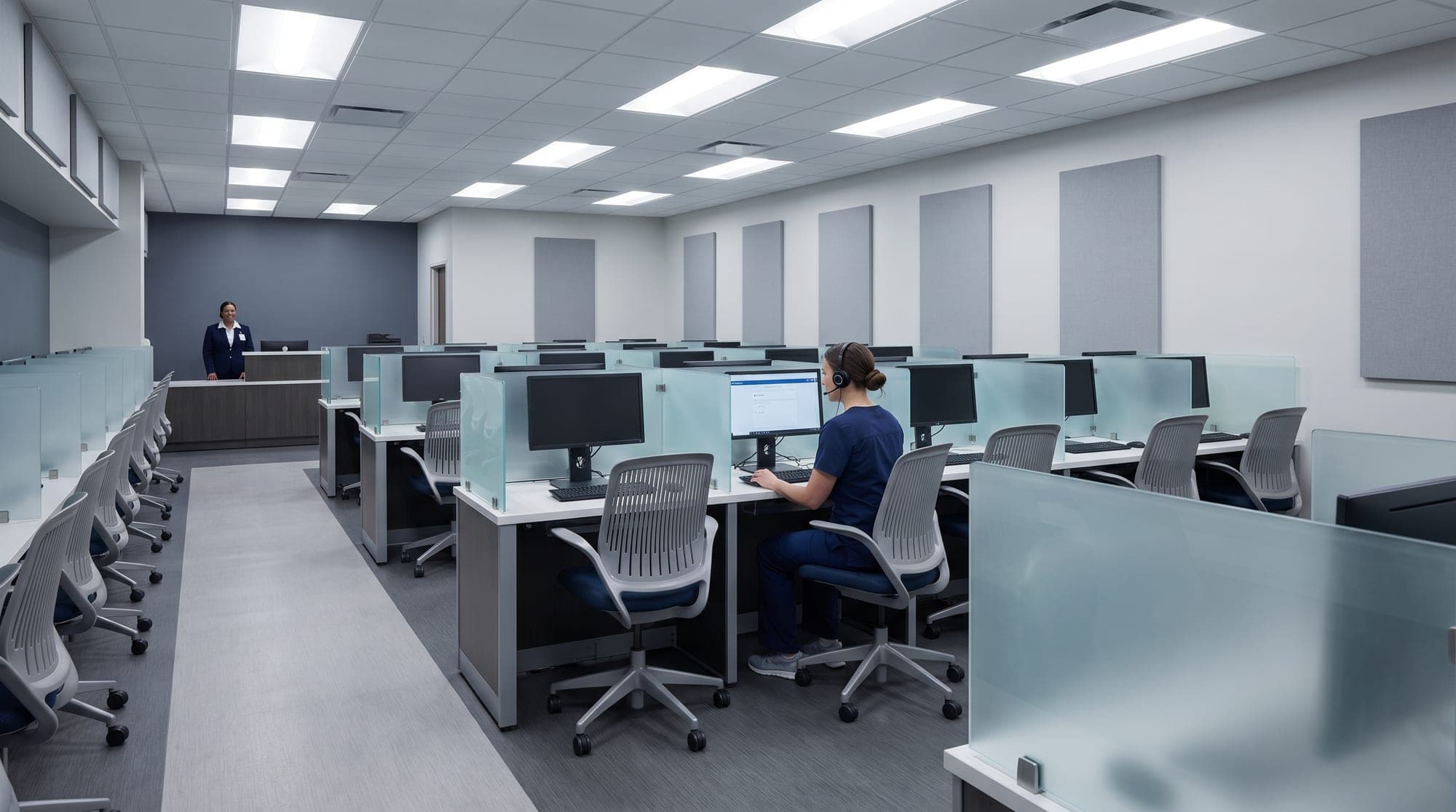
The testing room itself is quiet and bare — intentionally. You'll see:
- Private workstations with partitions (all BLE Training centers use solid, sight-line partitions, not low dividers)
- A computer with your exam loaded
- A blank whiteboard or scratch paper, plus a dry-erase marker or pencil
- A small tray for the ID you need during the exam
- Cameras recording the session (this is standard Pearson VUE policy, not unique to any center)
A proctor is in the room or immediately adjacent. If you need something — a bathroom break, a new whiteboard, a clarification on exam rules — you raise your hand.
Breaks: some exams allow them; some don't. Your exam instructions make this clear. Use the bathroom before you start.
5. The exam itself
Exam format varies wildly — multiple choice, simulations, drag-and-drop, or case studies — but the mechanics are the same:
- Your timer runs at the top of the screen
- You can flag questions to come back to
- Most exams let you review flagged questions before submitting
- When you submit, the result is usually immediate
The emotional arc of most test-takers is: anxious for the first 10 minutes, settled for the middle 60%, wobbly for the last 15%. That's normal. Trust your preparation. If you can't answer a question, flag it and move on — you'll often find the answer elsewhere in the exam, and returning with fresh eyes solves it.
6. After you submit
For most Pearson VUE exams, you see a pass/fail result on the screen as soon as you submit. A detailed score report arrives via email within a few hours to a few days.
The proctor collects your scratch paper/whiteboard, walks you out, and hands you a printed score summary. You retrieve your belongings from the locker and head home.
Why the BLE Training center experience is different
All Pearson VUE centers follow the same certification standards. What varies is the operational experience: how calm the space feels, how the staff handles check-in, whether the workstations have real partitions, how clean and quiet the environment is.
We take the experience seriously because we know the stakes. Every BLE Training testing centeris designed around the assumption that you've worked hard to get here — and the testing day should be the steady, professional hour that lets you show what you know.
If you're scheduling your first Pearson VUE exam, find your nearest BLE center, arrive 30 minutes early, and trust the process.